It’s the question that haunts us all at some point: what really happens when we die? One Arizona woman claims to have caught a glimpse, and come back with a message.
On February 12, 2018, Tina Hines was out hiking with her husband Brian when she suddenly collapsed on their driveway, the result of a near-fatal heart attack. Emergency services were called, and Brian attempted CPR until paramedics arrived. Tina flatlined multiple times before being revived, only to flatline again. In total, she was clinically dead for 27 minutes before being stabilized and intubated.
But it’s what happened after she woke up that left everyone stunned.
Barely conscious, Tina motioned for a pen and scribbled two words on a piece of paper: “It’s real.” When asked what she meant, she pointed upward.
To Tina, there was no ambiguity; she had seen something beyond. In interviews, she described the experience as profoundly peaceful and impossibly vivid.
“It was so real,” she said, per Yahoo. “The colors were so vibrant.” She also said she saw a figure she believes was Jesus, and described a deep sense of calm. “Unbelievable rest and peacefulness,” she told the Christian Broadcasting Network.
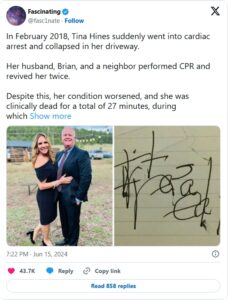
Brian, holding the paper as she scrawled her message, recalled being overwhelmed: “She just started making marks… I couldn’t even tell what it was at first. I was shaking. I just held the notebook steady.”
Tina’s experience had such a deep impact that she later wrote a book titled Heaven… It’s Real: How Dying Changes Living, published in 2021.
Tina isn’t alone. Stories like hers (often involving vivid visions, feelings of serenity, or encounters with loved ones or spiritual figures) are surprisingly common among those who have clinically died and been revived.
Scientists are still trying to understand what’s happening in the brain during these events. A 2013 study from the University of Michigan offered one potential clue: researchers found that the brain may become more active (not less) during the process of dying.
“A lot of people thought the brain after clinical death was inactive or hypoactive,” said Dr. Jimo Borjigin, who led the study. “But we show that’s definitely not the case. If anything, it’s much more active during the dying process than even the waking state.”
Whether it’s a neurochemical surge or something more transcendent, the experience can be life-altering and for people like Tina Hines, it’s enough proof that death isn’t the end of the story.