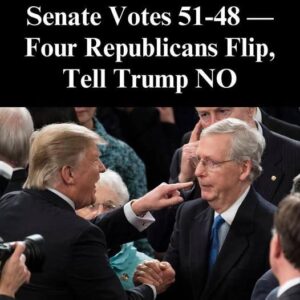
On a brisk spring day in early April 2025, the United States Senate issued a significant rebuke to President Donald Trump’s assertive trade policies. In a narrow vote of 51–48, the Senate passed a resolution opposing Trump’s proposal to impose a minimum 10 percent tariff on nearly all goods imported from Canada. The outcome was particularly noteworthy as four Republican senators—Rand Paul (R–Ky.), Susan Collins (R–Maine), Mitch McConnell (R–Ky.), and Lisa Murkowski (R–Alaska)—defected from their party to join the Democratic minority. Their votes highlighted significant divisions within the GOP and conveyed a strong message: even within a Senate controlled by Republicans, the administration’s extensive use of emergency trade powers would face resistance.
This article delves into the legal basis for the tariffs, the Congressional Review Act process utilized to challenge them, the debates on the Senate floor, and the strategic negotiations that took place behind the scenes, as well as the wider economic and political ramifications of this unexpected bipartisan coalition.
The Path to Dispute: Section 232 and the National Emergency Declaration
President Trump’s choice to impose tariffs on Canadian imports is rooted in his overarching “America First” trade doctrine. On February 13, he invoked Section 232 of the Trade Expansion Act of 1962, a rarely utilized provision that permits the president to implement trade restrictions based on national security concerns. Citing worries about the United States’ dependence on foreign steel and aluminum—and specifically, Canada’s position as the nation’s largest trading partner—Trump declared a national emergency and announced a 10 percent tariff on steel and aluminum, along with 25 percent tariffs on all other goods manufactured in Canada when the emergency was extended in March.
The rationale provided by the White House characterized the decision as an essential measure to safeguard American manufacturing and diminish the bilateral trade deficit, which is projected to exceed $20 billion in 2024. However, analysts pointed out that Canadian exports to the United States primarily serve to complement, rather than compete with, domestic production. Additionally, the administration’s expansive interpretation of “national security” prompted immediate international backlash: Canada threatened to respond in kind, the Mexican peso experienced a decline, and U.S. industries dependent on Canadian components—such as automakers, construction companies, and aerospace manufacturers—cautioned about significant increases in costs and potential disruptions in the supply chain.
The Congressional Review Act: A Mechanism for Reversing Executive Decisions
In response to escalating industry concerns and diplomatic repercussions, Senate Democrats turned to the Congressional Review Act (CRA), a 1996 statute that enables lawmakers to annul recently established federal regulations. According to the CRA, both houses of Congress can enact a joint resolution of disapproval for any “major rule” within 60 legislative days following its publication, requiring the president’s signature or facing a veto. Although this act has typically been employed sparingly and mainly against regulations from the opposing party, this week’s resolution aimed at a presidential proclamation rather than a rule from an executive agency, thereby testing the limits of the CRA.
Given the narrow Republican majority (51–49 in the Senate), Democrats required at least four votes from the GOP to achieve success. This was a high-stakes maneuver—if the resolution passed in the Senate but faltered in the Republican-controlled House, it would be largely symbolic. Conversely, if it succeeded in both chambers and overcame a presidential veto (a challenging prospect with Trump in office), it would eliminate the White House’s authority to implement the tariffs.
The Senate Proceedings: Discussions, Addresses, and Unexpected Developments
On April 9, 2025, the day commenced with speeches on the Senate floor that quickly highlighted the widespread concern that transcended party lines.
Senator Ron Wyden (D–Ore.), the primary sponsor of the resolution, characterized the vote as a safeguard for American consumers and allies: “We must not misuse emergency powers to impose burdens on our neighbors and penalize our own businesses. This undermines sound trade policy and threatens the regionally integrated supply chains that provide jobs in Detroit, Salt Lake City, and elsewhere.”
Senator John Thune (R–S.D.), chair of the Commerce Committee, expressed concern over the administration’s unilateral strategy: “We operate within a global economy. Tariffs act as taxes on American consumers and manufacturers. While I support strong borders, invoking national security in this manner is misguided.”
In contrast, proponents of the tariffs defended President Trump’s actions as bold and essential: